Sunday, 16 June 2024

Outer Hebrides 2 - North & South Uist

 15 – 17 May 2024

Whisky in the jar

After a smooth crossing we arrived at Lochmaddy on North Uist and headed to our overnight stop at Moorcroft campsite. On arrival there was a pitch with our name on it, so we set up and the owner popped over a bit later to welcome us. All very low key and friendly. Although it was raining overnight, in the morning we set off in sunny weather to drive south across North Uist, Benbecula, and onto South Uist (the islands being linked by causeways). The roads are mostly single track with passing places but with few trees and no hedges, visibility is good. We stopped for a while near Loch Druidibeag, where there is an RSPB nature reserve. Whilst walking from the parking area, we saw a white-tailed eagle on its nest, thanks to some keen birdwatchers who let us look through their telescope. 


There's a white-tailed eagle on that island...

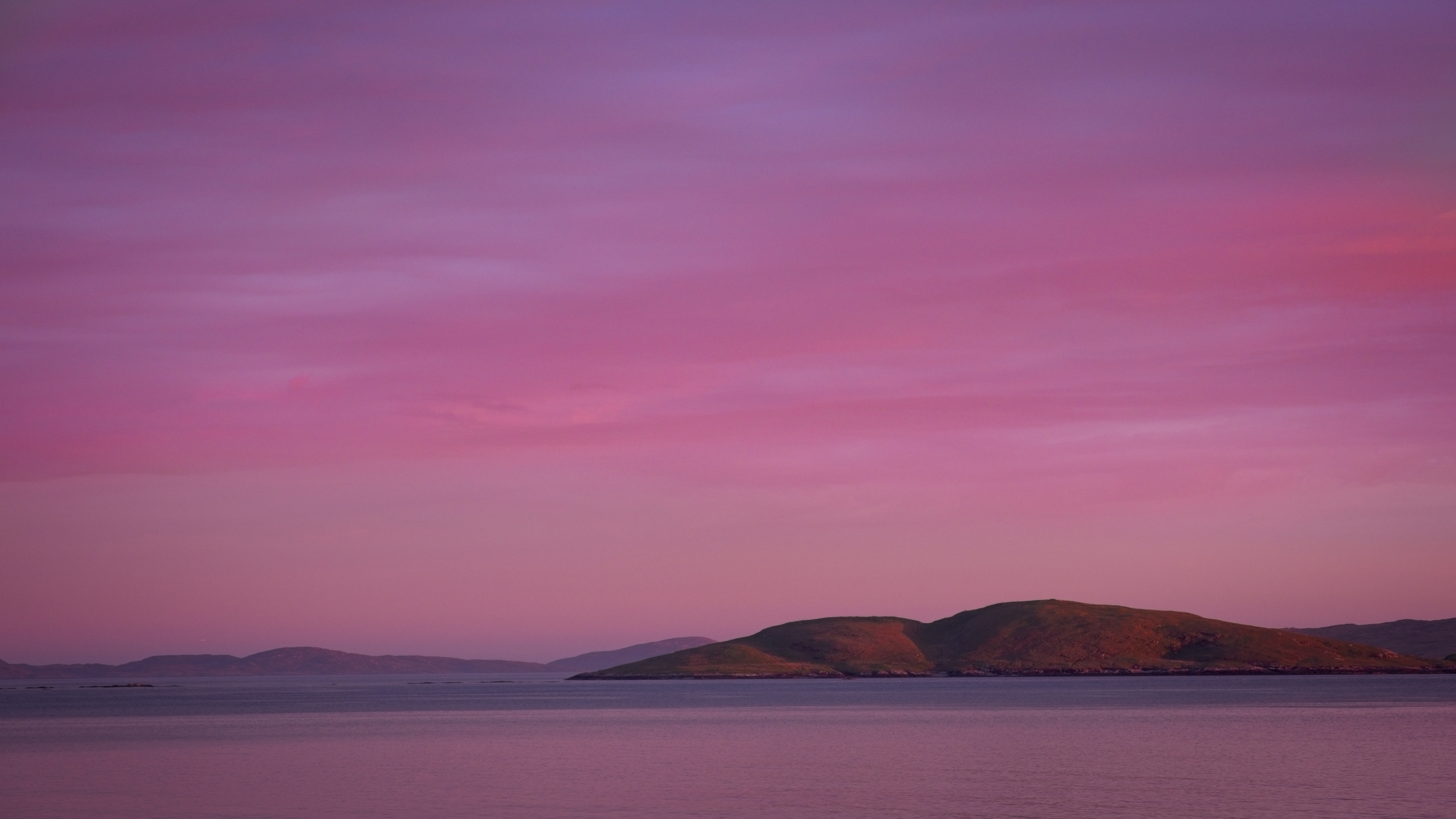
A visit to the Kildonan Museum gave a good insight into the history of Uist, but was probably just an excuse for coffee and cake in the cafe! Our next stop was on the southern edge of South Uist, at Kilbride campsite. There is a very good cafĂ© at the entrance, and we can recommend the fried breakfast! The site very peaceful and one evening we heard corncrakes while sitting outside and there was a spectacular sunset.


On our first day we used our new e-bikes to cycle over the long causeway to Eriskay. Just to the east of the road is the spot where, in 1941, the SS Politician ran aground. Amongst its cargo were 22,000 cases of Scotch whisky; this incident was the inspiration for Compton Mackenzie’s book “Whisky Galore”. 


We cycled towards the south of the Island, stopping at Prince Charlie’s beach, beside which is the ferry slipway for the crossing to Barra. As the name would indicate, this beach is the spot where Prince Charles Stuart landed in 1745 at the start of his ill-fated attempt to regain the throne of Great Britain.  


The next day we unhitched the bikes again and headed in the opposite direction, past Pollachara beach with its standing stone. 


We headed up toward the coast near Boisdale but the strong wind meant the ride was not as pleasant as it might have been. En route we called at the modernist church of Our Lady of Sorrows. Hebrideans are devout people and the plentiful churches seem to be frequently used. The islands are also a stronghold of the Gaelic language, all signs being bilingual.

We are pleased with the e-bikes - the motors have been much appreciated to get up hills, speed up to a passing place if there is other traffic and to battle the wind!


Outer Hebrides 1 - Skye

 9 - 14 May 2024

 Hebrides Overture

We’d tried, and failed, to get to Skye back in 2011, so another attempt was overdue. However, having seen a lot of photographs from the Outer Hebrides, gradually the plan evolved, and Skye became the start point for our adventure. Ferries and campsites were booked, and we were ready for the off.

Our first night was at CMC Strathclyde Country Park, conveniently located close to the M74, the drawback being the traffic noise. Otherwise the usual high quality site with the added bonus of warm sunshine.  There's a loch nearby which you can walk or cycle around if you want to stretch your legs.

 
The route to Skye could be navigated by lochs, rather than by road numbers: Lomond, Leven, Linnhe, Lochy, Garry, Loyne,Cluanoe, Duich, Alsh, then over the bridge and on to the Skye Camping and Caravanning Site at Edinbane. We had underestimated how long this journey of 237 miles would take and regretted not having time to linger on the way. We did manage to sneak into a car park alongside Loch Duich to photograph the iconic Eilean Donan castle


Although our pitch was not by the water, it was elevated and looked out over Loch Greshornish and we enjoyed a pretty sunset.


Due to a leisurely start next day there was a lot of competition for the available parking on the Trotternish peninsula and no chance of stopping at The Storr at the first attempt. We drove on to a new and fairly empty car park near Loch Mealt where there was a viewpoint and waterfall....


 ...and then headed back the way we had come and managed to find parking to enable us to climb up towards The Old Man of Storr. Even though we took the easier route it was still quite strenuous. The views were impressive, but would have been even better without the gloomy weather.


The forecast rain held off .... for the time being. However, back at the site we had a thunderstorm, which didn't last long, but heavy rain resumed just as John set off to do the washing up!

We opted to use the bus on Monday to go into Portree. The bus service was a bit limited but enabled us to do a short walk around the edge of the bay to Black Rock, where it's possible to see seals or sea eagles; sadly we saw neither. We then found a restaurant for a delicious fish and chip lunch before a look at the colourful buildings along the harbour.


The bus back was one of the many used by the school children, ferrying them back to distant places on Skye. The rather curmudgeonly driver was very strict with them.

On Tuesday we drove up to Uig (pronounced oo-ig) for the afternoon ferry to Lochmaddy on North Uist. It was a miserable, wet and foggy morning which put us off any exploring in that vicinity. The terminal is undergoing a £3.5 million redevelopment, due for completion in Spring 2025.

Even in early May Skye seemed very busy. We didn’t see the dramatic scenery at it’s best, due to the rain and haziness. However, the gorse and carpets of bluebells were very colourful.

Farewell to Skye


Tuesday, 11 July 2023

Austria 10: The journey home

 5 to 11 July

I'm Going Home

We crossed the border back into Germany under the watchful eye of the border police. Should we smile or look away? We obviously looked honest citizens as we weren't stopped but we felt a bit sad to be leaving Austria. 

We shall certainly try to avoid using the A8 on any future travels; traffic was very bad again around Munich, not just where the motorway is being widened from six to eight lanes. And we have never seen so many lorries as there are on this road. Camping Bella Augusta was very easy to find, just off the motorway, so some traffic noise was inevitable. It's also near an airport, but flights are few and far between. 

The foible of this site was the self check-in machine, for use when reception was closed. After entering all the details required, it showed you which pitches were available and having chosen one, you paid by card. "Simples!"

To stretch our legs we had a short walk by the lake which can be accessed from the site. Walking or cycling all the way round looked possible, with a cafe/bar/restaurant along the way.

The next halt was to the west of Stuttgart near Calmbach planned so that we could meet my German friend, Silvia, who had travelled down from her home near Speyer. Nothing more was required the first afternoon than the shady patio of the site restaurant and Kaffee and Kuchen for a long chat.


Silvia drove us into Calmbach later on to find a restaurant for dinner but it was a very quiet place and nowhere caught our eye. So it was back to the site restaurant, which turned out to be a great decision; we had a most delicious meal.

Silvia was delegated "tour leader" for the next day and she drove us to Bad Wildbad to spend time on elevated installations. First was the treetop walk leading to a 36 metre high lookout tower. You could see for miles, pretty much nothing but trees and there was an option to slide back down in the chute (no takers in our party).


Walking through the forest once back down below we passed hundreds of stacked rocks or cairns or inukshuks. A website informed me:
"Cairns or inukshuks are a pile or arrangement of rocks used to indicate a route, landmark or summit. The word cairn originates from the Scottish Gaelic word carn. A cairn or inukshuk can be either large and elaborate or as simple as a small pile of rocks". My version probably fell into the "small pile of rocks" category!


Ruth's cairn


Our walk then brought us to the Wildline suspension bridge, a 380 metre stretch of terror, 60 metres above the ground, which you stupidly pay to cross! We were all glad there was very little wind.


Next day, having said goodbye to Silvia, we set off for Chalons-en-Champagne (which, of course, you will remember from 33 days ago). It was a long journey and very hot so when we were offered a shady grass pitch instead of a sunny hard standing, it was a no brainer. It was a lovely pitch tucked at the back of the site, which raised our opinion of the site. If any excuse was needed we raised our G & Ts to the third from last night of our trip!


The night before the shuttle was spent at Chateau de Gandspette near Eperlecques, which had good reviews, and is about 35 minutes from the Channel Tunnel.  It was certainly a good site with large pitches and good facilities; worthy of a longer stay. We arrived in the early afternoon to give us time for the twenty minute walk to the Blockhouse (bunker) d'Eperlecques. This is where Hitler planned to build and launch the V2 rockets, also producing and storing the fuel there. Thankfully the plan never came to total fruition, being bombed on two separate occasions. The bunker is ENORMOUS, the main part being 92 metres wide and 28 metres high. The north side is more intact, the south less so.  Surprisingly you were also able to go inside, which I found very intimidating.  An interesting couple of hours, if rather dark.


Full size model of V2 rocket inside the bunker


V1 rocket on launch ramp

The Eurotunnel section of the return journey was a little too efficient. We arrived in plenty of time for our booking and were not surprised to be offered an earlier slot. Having accepted it however, we were required to start the boarding procedures immediately so there was no time to go into the terminal for the all important cup of coffee.

We spent the day with Mum and the night at Bearsted (again!) where John noticed a sign indicating that his new favourite Magnum flavour, Double Sunlover with white chocolate, mango and coconut is now available in England too!


Looking back over the past five weeks we appreciated what a great adventure we have had. We have seen some superb scenery, been blessed with good weather on the whole, have enjoyed some cultural activities, learnt about historical events and on occasions been able to share our experiences with friends.  Fantastic!  


Wednesday, 5 July 2023

Austria 9: Salzburg

2 - 5 July

The Sound of Music

It was a little illogical to be heading back to Salzburg at this point but due to time constraints we hadn't been able to fit it in earlier in the trip. The quickest route was to head north on the motorway into Germany (where there was congestion at the border) and then east back into Austria and to Salzburg, about 100 miles.

It's all very well having a ban on lorries travelling on motorways on Sunday (Saturdays too in Austria) but it does mean that there are millions of the blighters parked up at service stations. However Raststation Inntal, near the German border, had a huge number of car parking spaces so was a good find. And Coffee Fellows had Americano and decaff coffee on the menu so we were both happy.

It had been a wet journey; we had thought we might stop by the Chiemsee but you could barely see across the lake. Thankfully it had brightened up by the time we got to our site on the north side of Salzburg. We were invited to choose our own pitch, is that good or bad? It's actually easier to be allocated a space, even if you don't like it!

Having worked out how we wanted to spend our two days in Salzburg, buying the Salzburgkarte for free bus fares and entrance into many attractions seemed a good idea.  There was a bus stop 200 metres from the site entrance and we were in Salzburg by 9.20 am.  First stop was the house where Mozart had spent some of his life (not his birth place). It was not a large place and was largely a reconstruction as much of the building suffered bomb damage during WW2.

Mozart's Forte Piano


Later on after bumbling through the old town we timed a visit to the cathedral with a lunchtime organ recital. It's a beautiful place, decorated with carvings and paintings, rather than heavy gold and stained glass windows.


There are no less than seven organs in the cathedral and the organist played a total of six pieces on five of them. Between pieces while he scurried to the next organ, a member of the cathedral gave us some information about the cathedral, in German and English. So a comprehensive event.  After lunch at Siegl-Keller, whose terrace overlooks the old town, we used the funicular railway to get to the Salzburgforstung (fortress). There were good views from the ramparts and interesting displays inside about all aspects of the fortress.


On our second day we walked through the pretty Mirabelle Gardens, where the song "Do, Re Mi" from The Sound of Music was filmed. And indeed we did see a tour party being encouraged to sing the song by their leader! 


Later in the day we attended a harpsichord recital in the Old Residence, a very intimate affair with just 35 seats in a tiny room. The harpsichordist treated us to a variety of pieces, including Mozart of course, and her fingers were flying!


There were a couple of photo opportunities outside, firstly the horse and carts waiting to take you on a trip around the town and secondly an organ grinder; John put a coin in his cap so that I could take a photo as he took his hat off in thanks.  


To round off our visit to Salzburg, and indeed Austria, we had Kaffee/Iced Tea (no decaff!) and Kuchen - and very yummy it was too!

Monday, 3 July 2023

Austria 8: Pinzgau and Zillertal

 28 June to 2 July

Trains and boats and planes

The good weather seemed to have deserted us but at least it had stopped raining when we left Zell am See.  We arrived at our next halt early afternoon - a "Stellplatz" (camper stop with minimal facilities) behind a pub/restaurant up a track a mile from the main road. There was a signpost indicating several walks and at random we picked one for 30 minutes to Wald in Pinzgau. This was downhill through forest,  fairly steep in places, across a stream via stepping stones.


We got to the destination in 35 minutes, so felt we weren't too far off the pace. The Pinzgauer Lokalbahn, a narrow gauge railway built to serve the local community and formerly to transport timber, is currently closed between Niedernsil and Krimml due to flooding and a landslide in 2021. The unused railway line looked very sad. 


After the climb back it had brightened up so we drank tea in the weak sunshine overlooking the town of Rosental. There was also an area at the edge of the site for flying model aircraft so I went over to chat to the three chaps there and asked if they would mind if I took some photos. The photos of the plane were hopeless (in my defence it was flying very fast and quite far away) but I took a few of the operators as well.  


In the evening we walked all of fifteen metres to the Gasthof for a very nice meal. We felt very much in the heart of Austria.

The waterfalls at Krimml were next on our itinerary. Another steep and zig-zagging route to the top, this time on foot; there's a lot of "up" in Austria! The gravelled path closely follows the falls with viewpoints so the frequent stops for photos extended the suggested time of 1 hour 15 minutes to the top. Coming down was so much quicker. Apparently 176 million cubic metres of water thunder down each year.


We then drove for about 1 hour 15 minutes through the Gerlos Pass to get to Jenbach. From there you can ride the Zillertal railway to Mayrhofen, by either steam, diesel or a combination. This necessitated a trip on the bus (free with yet another visitor card!) to get to the station. John worked out the timetable, although we were waiting on the wrong side of the road initially.  It was a pleasant ride through the Zillertal, with the clickety-clack sound and smell of smoke to accompany us. The weather was showery and ribbons of clouds hung in the valley.


We passed one of the largest wood processing plants we have seen to date. Piles and piles of stacked trunks, some stripped of their bark, machinery producing wood chip and sawdust and finished planks of wood stacked under cover.

The area is very rural and we have frequently seen tractors spraying possibly liquid fertiliser on the fields. It doesn't half pong!

We repeated the trip to the station next day, this time to ride on the Achenseebahn cog railway, which climbs steeply and then descends a little to reach the Achensee. We felt sure we could hear the engine say "I think I can, I think I can" as it laboured up the hill (for those of you who remember Rev Awdry's books).


The weather was overcast and cool and we were decidedly chilly by the time we reached the end of the line. This was conveniently a stone's throw from the pier to get onto the boat for a trip around the lake. We headed straight for the restaurant for a hot drink followed by a hot lunch to warm up. It was a pleasant two hour trip around the emerald green waters (due to the limestone cliffs) of the lake.


Pertisau


You can use the boat as a hop on hop off service but because the weather had put us off the early start we originally intended, we weren't able to investigate Pertisau, which is where Elinor Brent-Dyer is believed to have written her Chalet School books. (Sorry, Louise). The return train journey was extremely noisy as the engine braked us against the gravity and I did wonder what the driver was looking at as he leaned out of his cab!


Tuesday, 27 June 2023

Austria 7: Hohe Tauern National Park

25 - 28 June

Rocky mountain high

It was only 25 miles to our next planned stop at Heiligenblut but we set off reasonably early in order to have a relaxing afternoon there. The site was idyllic, rather like being in someone's very large garden. The mountain views were lovely, facilities excellent and a restaurant/bar if you wanted it.


Heiligenblut is at the start of the Grossglockner mountain pass through the Hohe Tauern, which is where we headed next morning.  There was no way I was going to drive up and down the steep road with 36 hairpin bends and John did a superb job. We climbed from 1300 metres at Heiligenblut to a maximum 2571 metres at Edelweiss Spitze, the road's highest viewpoint, stopping frequently to take photographs and/or let the van's brakes cool down.

The road you see goes right around the mountain

There was a very interesting exhibition about the history and construction of the road at Fuscher Lacke. The  Glockner route dates all the way back to the second millenium BC (supported by archeological finds). The current pass was built between 1930 and 1935 but allowing for winter breaks, work was only possible for 26 months of those five years.


The whole experience was amazing but the side road up to Franz-Josefs-Hoehe (2369m) to view Grossglockner itself and the Pasterze glacier was the definite high spot (excuse the pun!)  Another interesting exhibition on the glacier and wildlife was located here at the Wilhelm-Swarovski observatory.


On leaving the pass we found our campsite, a "holiday park" which was not our first choice, but the site where we would have liked to stay was fully booked. While there we cycled along the flat cycle path to Zell am See in one direction and towards Kabrun in the other.

Zell am See from the end of the lake

Swans and cygnets by the lake