Monday, 1 July 2019

South West Scotland - 3


Jun 13 - 16 2019

 A New England

On the way to New England Bay, in the South Rhins of Galloway, we stopped in a lay-by with lovely views over the island of Ailsa Craig (beloved of bored cameramen during golf from Turnberry) and the Firth of Clyde and then at Portpatrick.

Ailsa Craig
This should have been a pretty little fishing harbour, where you could sit outside one of several cafes watching the world go by.  In reality, it was cold, gloomy, with very few people about and we had a quick walk around before hastening back to the 'van.  On a positive note, there is a lifeboat station there, and John purchased his normal quota of RNLI Christmas cards!

Gloomy Portpatrick

The CMC site at New England Bay stretches for quite some way along the coast and you can walk in either direction.  And you see plenty of birds from the comfort of the 'van.  The only way to get to the Mull of Galloway was to take the van and John bravely tackled the winding B-road with high hedges, followed by the single-track road with passing places, a total of 5 miles.  Just before the Mull, we literally had to nudge our way through a herd of cattle and calves. 

But we arrived unscathed and the scenery and views over Luce Bay and the Irish Sea were well worth the journey.  The Lake District Fells and the Isle of Man were clearly visible, with a dark smudge on the western horizon indicating Northern Ireland. Unfortunately, the lighthouse tours were not taking place due to a wedding later in the afternoon, but we did a circular walk around the Mull, ending at the RSBP visitor centre, where the volunteers were delighted to chat about the many birds in the vicinity.

Mull of Galloway

From New England Bay we cycled 2.5 miles on minor roads to get to Logan Botanic Gardens, which is part of the Edinburgh Botanic Gardens. Its specialism is plants from warm climates of the world.

Logan Botanic Garden

It was then time to head east, following the coast past Auchenmalg Bay and Port William, before cutting across to Withorn.  This is where "St Ninian, the first apostle of Christianity in Scotland, is believed to have built his church Candida Casa.  For centuries, commoners and kings have visited the shrine of the saint.  The settlement grew to become Scotland's first town".  The detailed exhibition was very interesting but we only scurried round the remains of the church, as it was raining again.

South West Scotland - 2


7 - 12 Jun 2019

Fly like an Eagle

From Muasdale we retraced our steps slightly, to catch the CalMac Ferry from Claonaig to Lochranza on the Isle of Arran, a short 30 minute trip. To reach the ferry you drive down several miles of single-track road (with passing places) and on arrival, the “Ferry Terminal” is, in fact, a slipway and what looks like a bus shelter.


The Lochranza Campsite is very peaceful (no main road nearby!) and there are plenty of walks to keep visitors occupied. Once we were settled on our pitch, we picked up some leaflets on local walks from the helpful staff at reception and headed off up Gleann Biorach. This was a short walk in pleasant sunshine, and we were delighted to see a pair of Golden Eagles soaring above the rocks on Torr Nead. 

Lochranza campsite


Looking for eagles

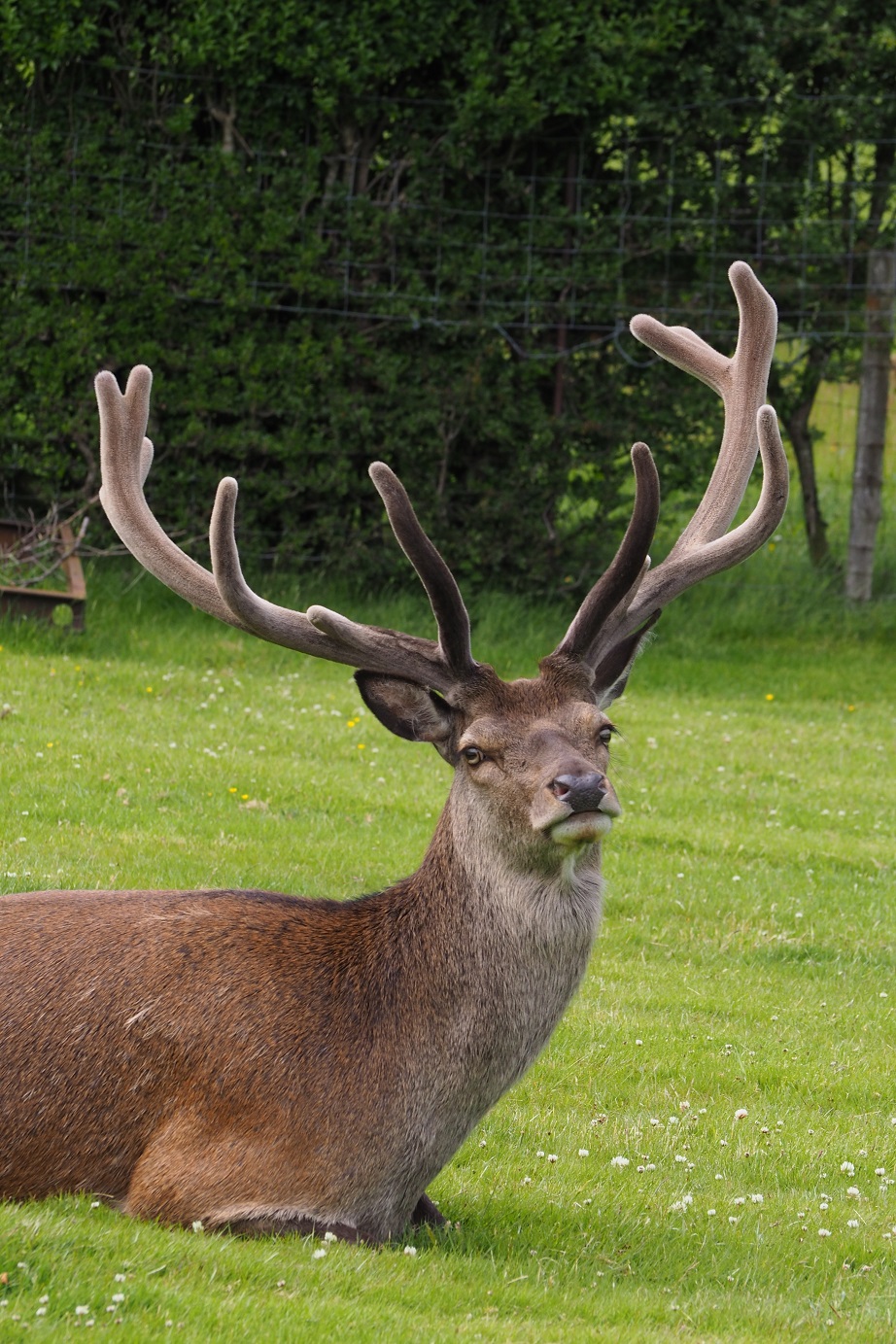
In order to see more of the island, without having to move the motorcaravan, we used the local buses to get to Brodick on the east side, then across to Blackwaterfoot in the west, travelling back to Brodick along the southern coast. This was the only day (so far, fingers crossed) that we have got really wet and we hid for a while in the Arran Heritage Museum until it was time for our bus. On Sunday afternoon we took another of the recommended walks, around the headland to the north of Lochranza. Walking out from the pitch, we passed nine red deer just outside - and even just inside - the campsite. 


On our way back, we saw another Golden Eagle, high above the hills. Glorious sunshine on Monday was an inducement to walk into Lochranza (about 15 minutes) to take some photographs of the castle and bay.


From Arran our journey continued with a 55 minute ferry crossing to Ardrossan on the mainland and then to Culzean Castle, where there is an excellent CCC site.  From our pitch we looked out over Arran and hoped for a spectacular sunset - in vain!  

The estate at Culzean is enormous, with several marked trails to follow, leading to points of interest such as the camellia house, the swan pond and the biggest walled garden ever.  One of the current projects for National Trust for Scotland is to restore the walled garden to its former glory and we chatted to some of the workers who were planting squares of yew trees, each cage containing 25 trees, which will eventually cover the cage.  We joined a guided tour around the castle and had an excellent guide who mixed his facts with plenty of humour.
Culzean Castle

Inside the walled garden


South West Scotland - 1


30 May – 6 Jun 2019

Mull of Kintyre


It was not a promising start to the trip; we had left Stratford in the sunshine, but by the time we reached the Lake District, the rain had set in. It continued to rain at our overnight stop in Moffat (same site as 2017 – CCC site) and was still raining when we left the next day. Thankfully the skies cleared by the time we reached Edinburgh. We had come North to join the rest of the family to celebrate Jocelyn's first birthday; she enjoyed all the company, the attention - and the wrapping paper!

We spent two nights at the Mortonhall Caravan Park just inside Edinburgh’s city by-pass. The site is big, well organised and has good facilities. From Edinburgh we skirted Glasgow on the M8, and followed the southern end of Loch Lomond.  It was a very gloomy morning, but the roads were brightened by the abundance of deep pink rhododendrons.  Glen Croe was stunning even with the clouds covering the hilltops and at Rest and Be Thankful, six miles beyond Arrochar, we did just that, stopping at the Argyll Forest Car park. 

View down Glen Croe

From there you look down on the Military Road, constructed in the 18th century, as part England’s attempts to quash Scottish rebellions.  And looking up, you can see Ben Arthur, aka The Cobbler, (when not shrouded in cloud!).   The A83 then took us along Loch Fyne, passing through Inverary, on our way to a three-night stay at Lochgilphead Caravan Park.

We easily filled the time in Lochgilphead with a visit to the Kilmartin local history museum, following this up with walks to a cairn of stones, the Nether Largie standing stones, Temple Wood stone circle and the ruined Carnassarie Castle. There was also a visit to Arduaine Garden, National Trust for Scotland, where the main feature of the lower garden is the giant rhododendrons, sadly past their best.  The upper garden is mainly woodland. 

Standing stones at Kilmartin

The bikes were unloaded the from the back of the van and we had a lovely ride along the Crinan Canal to Crinan lock basin (7 miles), passing the south side of the Moine Mhor (peat bog).  There were plenty of other folk on the towpath, cycling or walking their dogs, and many boats negotiating the locks.  As I was taking a photograph of a pretty cabin on the other side of the canal, a male cyclist, a Canadian, passed me and apologised that he was not able to invite us in to his residence, but he was off to Lochgilphead to do his shopping.  It seemed rather like an extract from Wind in the Willows, which we took Ben to see the other week!  The resident turned out to be an artist, Fraser MacIver, who has had his home studio on the canal since 1997.  

Fraser MacIver's studio

 
Crinan Basin
On our way to the next site at Muasdale we stopped briefly in Tarbert and walked rather quickly in the rain around the castle ruins.  The "site" at Muasdale was tiny, right beside the beach.  Also right next to the A83!  We were only there one night, but had a couple of enjoyable walks along the beach and could see seals on the rocks a little way off the beach. Sadly the hoped-for sunset over the islands of Islay and Jura did not quite materialise – maybe next time!

On Muasdale beach


Evening on the Sound of Jura


Friday, 17 May 2019

Hereford and Tewkesbury


May 8 - 13 2019

The History Boys (and Girls)

Post from John

Time for our first “proper” trip of the year – and like 2018, it was to be a short break with our friends Barbara and Clive. Our rendezvous was at Brockhampton Estate, a National Trust property west of Worcester. This medieval manor house, later a more humble farmhouse, provided an interesting and enlightening few hours (after the obligatory visit to the tearoom).


Our base for the next couple of days was the Caravan Club affiliated site of Lucksall, about 4 miles outside Hereford. This proved to a an immaculately kept site, nestled alongside the River Wye, with some of the largest pitches we’ve ever seen. The next morning saw us catching the bus from outside the site entrance, bound for Hereford. The day was dull and rainy, so inside activities were in order. First up was the wonderful “Brick History” exhibition in the city library, with significant events from the past (the Big Bang, the destruction of Pompeii, the Boston Tea Party…) recreated in Lego.

Then on to the Cathedral, not just to admire the wonderful architecture, but to visit the Mappa Mundi. Dating from around 1300, this is the largest medieval map believed still to exist. Amazingly detailed, it served as both a geographic and theological document. 


Part of the Mappa Mundi

Friday was better weather, so we all donned our walking boots and set off on a circular walk that Clive had researched. The route took us through the nearby village of Mordiford, then alongside the river before heading up into the wooded hills. After a picnic lunch in the woods, we ended up back at the pub in Mordiford for a welcome drink.

The next morning, we had a leisurely start before driving the short distance to Tewkesbury Caravan and Motorhome Club site. This is situated in the heart of the town, close to the abbey. It was to the abbey we headed in the afternoon, and were intrigued to watch rehearsals taking place for an operatic performance that evening. The sounds of strings and voices were a fitting backdrop as we explored the building, reckoned to be one of the finest examples of Norman architecture in England. A short wander around the town completed the day.


Clive was out and about early with his camera on Sunday morning, to photograph the Tewkesbury marathon, the route of which passed close to the site. The rest of us joined him a little later, and walked to short distance to the Avon, watching narrowboats manoeuvring on the river, before crossing onto the Severn Ham. This is a large area bounded by the Rivers Severn and Avon, which is a Site of Special Scientific Interest, and home to many varieties of flora and fauna. As we walked around the area, Clive and Barbara improved our wildlife knowledge by identifying the various birds we could hear and see.


After lunch we had a stroll around the area known as the vineyards, south of the abbey, site of some of the final fighting in the Battle of Tewkesbury, a decisive engagement in the Wars of the Roses. The Yorkists heavily defeated the Lancastrians, some survivors of whom fled to seek sanctuary in the Abbey, only to be dragged out and summarily executed.


On Monday we packed up and made the short (1 hour) journey home, once again having had an enjoyable time more or less on our doorstep.

A slightly longer trip coming up next….

Monday, 22 April 2019

Broadway


16 - 18 April 2019

All shook up

Post from John

Boat owners will be familiar with the concept of the “shakedown cruise” – the first trip after the winter lay-up, checking all systems are working correctly. With a spell of good weather forecast in the run-up to Easter, we thought we’d take the opportunity for a short trip in Amelia to check all was well, before longer trips later in the year. One complication – Ruth’s mum was staying with us. So, we decided that we’d take the van the short distance down to the Caravan and Motorhome Club site at Broadway, and use it as a base for a couple of days. I’d stay in the van, and Ruth and Mum would come down each day.
Broadway is the archetypal Cotswold village; all honey-coloured stone buildings, boutique shops and tea rooms. Whilst the ladies spent the morning in the village, I followed on in the van a little later and went straight to the site. This is on the edge of Broadway, right next to the Gloucestershire & Warwickshire Steam Railway. As the picture below shows, if you pick the right pitch, you have a great view through the window…..


We spent the afternoon in the van, checking everything worked, (which it did) and relaxing outside in the sunshine.

The next day we headed across the road to the station for a trip on the railway. The beautifully rebuilt Broadway station opened in early 2018, as part of the extension of the GWSR from Toddington in Gloucestershire. The 4 miles of new line is the result of over £1.1 million fund raising efforts, and a huge amount of work from the volunteers. We had an enjoyable few hours riding down to Cheltenham and back, followed by another spell of sitting in the sunshine. The relaxation was punctuated by the occasional rush up to the fence to photograph the passing trains.


After another quiet night in the van, on Thursday I drove Amelia the 40 minutes back home, where we emptied and restocked ready for the next trip. All in all, a successful few days, and proof that you don’t have to journey too far from home to have an enjoyable break.

Wednesday, 10 October 2018

Derbyshire


27 September – 2 October 2018

Happy Trails

Post from John

The summer sort of ran away from us….
As mentioned in the last blog, we had another chunk of house rebuilding coming up (new kitchen). Add to that moving mother-in-law from Bedfordshire to Kent, and it was all a bit much. Anyway, by mid-September we were in in a “Dammit, we’re going to get away for a few days” frame of mind. A spell of good weather was forecast for the end of the month, so we hitched the bikes to the back of Amelia, and headed off to Derbyshire.
Our base was Beech Croft Farm, a campsite a few miles east of Buxton. This proved to be a lovely site, built on terraces in the side of a hill. 


On our first day, we headed off on the bikes to the Monsal Trail. The first half mile or so from the site was along a bridleway and then down a steep hill – not ideal for bikes. However, once on the trail (the track-bed of an old railway) the going was fine. The route took us over the Millers Dale and Monsal viaducts, both very impressive.


We cycled about 7 miles along the trail to the old Hassop Station, where we had lunch in the popular café there. Suitably fortified, we retraced our steps along the trail.

On Saturday we took the bus into the pretty market town of Bakewell. We walked around in the sunshine, along the riverbank with its’ historic bridge and up to the church, passing the old alms houses along the way.


The weather was a bit less promising on Sunday, so we opted to walk over the nearby hill to Chelmorton, where the Church Inn has a good reputation for food. It was rather more exertion than a typical stroll for Sunday lunch, but thankfully the Inn’s reputation proved well deserved.


Another day, another old railway to cycle. We left Beech Croft farm, and parked the van at Parsley Hay, on the Tissington Trail. We cycled off in the direction of Ashbourne, but our objective was Tissington itself, about 10 miles away. Once again we felt we’d earned lunch, so after some tasty soup at the rather nice Herbert’s Tea Rooms, we headed back to the van.


We had phoned ahead and booked a pitch at the Camping and Caravan Club site at Ashbourne (where we stayed back in 2012 on our first trip in a motorhome). It was clearly near the end of the season, as there were only four other units on site! So, a very quiet night before driving back home the next morning.
And that concludes our trips in Amelia for the year - only 18 nights away, the fewest since we started. However, we are determined to rectify that in 2019…

Wednesday, 1 August 2018

Pembrokeshire


14 - 24 July 2018

We’ll keep a welcome in the hillsides

Post from John

The required rest (see last blog entry) did not materialise. The end of May saw the arrival of our granddaughter Jocelyn, so June and early July meant that we (particularly Ruth) made several trips up to Scotland to be with Louise and the baby, especially when Steve’s paternity leave finished. Therefore it wasn’t until late July that we were able to load up Amelia for another trip.

Keen readers of this blog (you all are, aren’t you???) will remember that we aborted a trip to Pembrokeshire in 2015. With the forecast looking good, and now living 2 hours nearer, we decided to give it another try. We left in the middle of the heatwave, but arriving in St Davids we found the temperature to be several degrees cooler. Still nicely warm and sunny, though.

Our base was the Caravan and Motorhome Club site at Lleithyr Meadow, a few miles outside St Davids. The site is on the route of the Celtic Coaster bus, which, over the next four days, we used frequently. We spent one cloudy and slightly damp day in St Davids, the smallest city in the UK. The beautiful cathedral is the main draw, but it is discretely tucked in a hollow on the edge of town, not dominating the skyline.


The warm and sunny weather returned, and we enjoyed several walks along the Pembrokeshire Coastal Path. We walked from the site out to Saint Davids Head, then back to Whitesands bay. We took the bus out to the lifeboat station, and walked round the coast to arrive back at Whitesands from the other direction. Finally we took the bus out to Porthclais, then walked along the coast, past St Nons Chapel, to Caerfai Bay, and back to St Davids.
 
Saint Davids Head


Whitesands Bay

Having explored that area, it was time to move on to the southern part of Pembrokeshire. For the next three days we stayed at Tudor Lodge campsite, at Jameston, between Tenby and Pembroke. Whilst a pleasant enough site, we are rather spoiled by the high-quality facilities at Club sites.

Our first trip was to Pembroke, where after a pleasant wander along Main Street, we walked back alongside the Mill pond for a delicious meal in the Watermans Arms. After lunch we headed for the main attraction – Pembroke Castle. Birthplace of Henry Tudor, later Henry VII, the castle has a turbulent history, from Norman times to the Civil War. Plenty of displays and guided tours made for an enjoyable and informative visit.


The next day we took the bus in the opposite direction, to Tenby. The NT owned Tudor Merchants House was an interesting insight into life in Tudor times, but otherwise we walked around the town and the promenade, watching the influx of visitors (first day of the school holidays).

On Sunday we put our walking boots on again, heading southwest from the site, through the fields to Swanlake beach, then along the coast path to Manorbier. Refreshments in the tea room in the village were most welcome, before we headed back to the site.
 
Swanlake Beach


Monday morning we moved on, heading towards home, but breaking our journey first at Aberdulais, where the old tin works and waterfalls are now NT owned. Once again, films and displays educated us, this time in the making of tinplate, a hard and sometimes dangerous task in the 19th and early 20th centuries.


We finally moved on to the Caravan and Motorhome Club site at Pandy, on the edge of the Brecon Beacons National park. Sadly, this was just an overnight stop, but Brecon is on our “to visit” list for another time.
Tuesday saw us heading home, ready to start the next of the major house projects.