Tuesday, 26 September 2017

Orkney (2)

20 – 22 September

Farewell to Stromness

In the nick of time we saw the notice on the facilities block door saying that the exit from the site would be closed between 10 am and 2 pm while the road was resurfaced.  So our departure was a little more hurried than usual ….

The weather forecast remained unpromising, but we headed to the Brough of Birsay at the northwest tip of Orkney, where, at low tide, you can cross the causeway to see the lighthouse and various ruins.


It looked rather bleak so we settled for a photograph and walked instead to the Skiba Geo, a deep cleft in the rocks which was used as a harbour, with a fisherman’s hut and nousts (shallow depressions in the ground for boat storage) a little way up the bank.


After a leisurely lunch it was back south to Skara Brae, a magnificent village from the Neolithic Age (New Stone Age) which dates back to around 3000 BC.  It has survived so well partly because it was made of stone, and partly because it was semi-underground.  It wasn’t so much discovered, as emerged after a particularly bad storm in the 1950s.


We then headed to the site in Stromness; we missed a camping sign and found ourselves inching our way through the extremely (and I mean extremely) narrow roads of the heart of the town.  Lesson learned: always put the satnav on!


Next day included a brief explore in Stromness, a drive along the road along the south of the island and finally a pleasant walk from the campsite along the coast on a tarmac path overlooking the islands of Hoy and Graemsay.  While we were out we watched the evening ferry pass through the channel between these two islands and Orkney mainland*.  We even had some pale evening sunshine!


On Friday we had a few hours left before returning to Scotland on the ferry.  Ring of Brodgar, a Neolithic henge and stone circle, was still on the to do list.  It is generally believed to date from 2500 BC to 2000 BC and was probably used for ceremonial purposes.  Only about half of the sixty or so stones are still standing but it was very atmospheric and gave a feeling of the scale of the site.  Just a shame that as a result of ongoing drainage works, many of the stones were surrounded by fences!


The final outing on the Orkney itinerary was to Yesnaby, which is really wild coastline with steep sided inlets, sea stacks and arches resulting from erosion.


Then it was time to get the ferry back to Scotland*.  It was incredibly windy and the sea looked pretty rough, but, in actual fact, it was probably a smoother ride than on the outward journey.


*As Ian Banks has written in “Raw Spirit”: On Orkney never call Scotland ‘the mainland’. Orkney has its own Mainland; that’s the correct name for the big island that Kirkwall and Stromness are on.  Scotland is called Scotland.

Tuesday, 19 September 2017

Orkney (1)

17 – 19 September

A Day without Rain

The hour and a half sailing to Scrabster was reasonably calm (thank goodness) and we admired and photographed the sea stack “The Old Man of Hoy” as we passed by.


Before heading to our site in Kirkwall we stopped off at the Standing Stones at Stenness, one of the many historical sites on the islands.


We spent the next day in Kirkwall, visiting the magnificent St Magnus Cathedral in the morning. Nearly 900 years old, the “Viking Cathedral” dominates the skyline of the town; inside however, inside decoration is very simple, only the stained-glass windows and the banners, celebrating 900 years since the birth of St Magnus, adding colour.


In the afternoon, John insisted on a visit to the Highland Park distillery. The tour was informative, following the whole process through the maze of picturesque old buildings. Highland Park still uses some old techniques (for example, laying out the barley to dry on large malting floors) and is proud of its use of as many local ingredients as possible. The visit was rounded off with a tasting; I still prefer brandy, however!


If you ignore the light shower of rain around 8 am, we had our first “day without rain” on Tuesday, 19 September!  Not only that, the sun shone and the temperature reached the giddy heights of 17 degrees C in the afternoon.  More please!  On this remarkable day, we drove south, over the Churchill Barriers, which were constructed largely by Italian prisoners of war during World War II, to protect Scapa Flow from attack by German submarines.


Just beyond Churchill Barrier 1 is the Italian Chapel, also constructed by Italian prisoners of war.  Such a beautiful place, and created from two Nissen huts, assorted scrap and a lot of genius.


The fourth Churchill Barrier takes you onto the island of Ronaldsay, where we headed down a single-track road to Hoxa Head for a walk along the coast, overlooking the Flotta oil terminal on the south side of mainland Orkney.  We intended to support the Hoxa Tearoom, but it had sadly changed over to winter opening hours, which do not include Tuesdays.


The final port of call was to the Tomb of Eagles, dating from approximately 3000 BC.  The name comes from the many talons and claws of sea-eagles found among the burials.  John dared to venture inside!


Prior to reaching the tomb itself we had had interesting introductory talks and a walk to a mound from the Bronze Age, which is believed to have been a workshop.


On the way back to the site, we commented that we had put in an eight-hour day – hard life!

Monday, 18 September 2017

Scottish Highlands - Dornoch to Scrabster

14 – 17 September


The Rocks and The Water

So we are now covering the NC500 in an anticlockwise direction …

Loch Fleet is only a few miles along the A9 from Dornoch. This was our first venture onto “single track roads with passing places”, very scary. However, there was very little traffic and the passing places were frequent, so it was easy (says the one who wasn't driving!)  There are car parks at the nature reserve or at Littleferry further on, from which you can walk across the Ferry Links.  We saw oystercatchers and osprey (we think!).


Dunrobin Castle looked interesting, but we felt we had insufficient time to justify the admission charge. A little further on Carn Liath, an ancient dwelling from the Iron Age (broch) turned out to be an interesting stop.


One thing we are finding is that places of interest are sometimes not well signed.  We had hoped to take a peek at the beach at Brora, but didn’t see a road leading to it.  The Ord of Caithness later on was similarly elusive.  However, there was plenty of parking for motorhomes at the harbour of Helmsdale and we took refuge from the rain in the Thyme and Plaice teashop/restaurant mentioned in “Wild Scotland” before completing the leg to Dunbeath, which is on the very last page of our road atlas!


Another day of unsettled weather followed as we made our way to Lybster, one of many herring stations developed in the 19th century, with its exceptionally wide main street.  However, the rain gave no incentive for us to stop here.  We did find the Whaligoe Steps at the second attempt, where 300 steps lead down to a large geo with deep water, which was used to land and ship herring and other fish.  The weather put paid to any thoughts of going down the steps.  However, the old curing house is now a cafĂ©, where we hid from the rain – highly recommended, but it is only open Thursday to Sunday.


We had only thought to stop at Wick for a visit to Tesco’s, but we were enticed by the Mackay’s Hotel’s No 1 Bistro, located on the world’s shortest street, Ebenezer Place (2.06m - the width of the building!) where we had a delicious lunch.


Then quite by chance we then came across the Telford Trail, an informative guided walk on the south side of the town.

The last stop of the day was at Ness Point (at the end of another single track road) to view the remains of Castle Girnigoe and Sinclair.  It was still raining, but had dried up by the time we reached John O’Groats for a night halt.


The next morning we drove the two miles to Duncansby Head (single track road ending in a large car park) and then walked a short way to the spectacular Duncansby Stacks to take some photographs. Sunshine and heavy showers were the order of the morning.  


After lunch in the ‘van we headed west to visit the Castle of Mey, the late Queen Mother’s residence.  This is a delightful place, very homely and would appear to be very much as it was when she was alive. There was a guided tour which was extremely interesting.


We spent the night at a site on the edge of Thurso, which is just a couple of miles from Scrabster, handy for the ferry to Stromness on Orkney next morning.

Thursday, 14 September 2017

Scottish Highlands - Moffat to Dornoch

7 -  13 September

The Mist-covered Mountains

The roads around the north coast of Scotland are by no means new, but now that they have been designated the North Coast 500 and received a great deal of publicity, they have been given a new lease of life.  So having seen a documentary on TV and read some magazine articles, we are off to see the sights for ourselves.

First stop: Moffat in the Scots Borders.  Louise came down from Edinburgh to visit us for the day and we spent the afternoon on a steep walk alongside the Grey Mare’s Tail waterfall, about 5 miles away. Deteriorating weather prevented us completing the walk as far as Loch Skeen, the source of the falls.
(I am the tiny blue speck on the path in the distance; John and Louise explored a bit further)

Walk along the GreyMare's Tail Falls
I think waterfalls are going to be a feature of this trip!  Next stop was at Killin, near Loch Tay, where a narrow stone bridge crosses the Falls of Dochert. A sunny afternoon meant that we unstrapped the bikes, following a route down to the falls, (rapids rather than falls, but quite impressive, as a result of the recent heavy rain) and a little way through woods above the town.

Falls of Dochert
Then on to Dingwall, via the Cairngorms, which remained invisible, shrouded in low cloud and rain.  Many of the grass pitches at the Camping and Caravanning Site were too muddy to use and instead we were instructed to park up on one of the access roads.  After that it was off to Ullapool (or Ullapul, if you are Scots!)  On the way, we stopped to view the Rogie Falls during a brief sunny interval, and I was very excited to see a salmon leap!

Rogie Falls
We made a further stop at Corrieshalloch Gorge and Falls of Measach, where there is a pleasant, short walk along the gorge, but sadly the bridge across the falls to the viewing platform is currently closed for maintenance.

Path leading down to the gorge; Ullapool in the distance
At this point we joined the NC500 proper, having chosen to miss out the leg around Applecross and Gairloch.

The site (Broomfield Holiday Park) at Ullapool is usually delightful, I’m sure. It has a lovely view over Loch Broom - but is also directly hit by any adverse weather from the north-west!  Sadly, this was our experience. We took our time selecting the least-sodden grass pitch (no hardstandings). After a broken night’s sleep due to the lashing rain and wind buffeting the ‘van, we checked the weather forecasts.  The weather on the eastern side of Scotland looked somewhat better, so we decided to jump ship, but required a tow from the site tractor to get us off the very wet ground.

We headed back towards Dingwall, calling at Blackwater Bridge and falls in Strathgarve, which we had missed on the outward journey.

Strathgarve
Then north to Dornoch, and what a delightful place that has turned out to be.  The site is just a ten minute walk from the small town, where the visitor centre, located in the Carnegie Courthouse, provides all the information you need, including walks and cycle rides.  And we can recommend the tea-room upstairs!  Improved weather enabled us to walk down to Dornoch Point, but we escaped a heavy shower by visiting the Historylinks Museum, which details just about anything to do with Dornoch and the surrounding area from times past to the present day - see www.historylinks.org.uk .   Did you know that Andrew Carnegie was a Scot, who later emigrated to America, but used some of his huge fortune to found libraries and centres for music and art? He bought Skibo Castle, about 4 miles from Dornoch, as a holiday home and to ensure that his daughter had a home in Scotland.


Tuesday, 11 July 2017

France - Normandy

2 July – 8 July

Brothers in Arms

We were ready to leave Villandry mid-afternoon so decided to travel on a little further, have an overnight stop at Ecommoy, and then complete the journey to Normandy on Sunday.  The site we picked at Creully in Normandy is very rural and peaceful, but with plenty of amenities, which ticked all the boxes for a relaxing day and a half.  It is also just ten minutes’ walk from the town centre, where there is small but comprehensive supermarket, much more to my liking than the hypermarkets where you walk miles to find what you are looking for!  Relaxation time over, we decided to book a third night and did a day trip to Arromanches-les-Bains, to visit the D-Day Landings museum, but a very pretty town in its own right. Motorhomers please note: the museum does not have motorhome parking and Arromanches-les-Bains is not the most motorhome friendly place to drive around!  However, there is both an aire de campling car (for about 12 motorhomes, tucked in a quiet cul-de-sac) and a municipal camp site, which looked fine as we passed by, and which also offered parking for the day or half day.

In June 1944. Arromanches was the site of one of the Mulberry harbours, temporary ports created to help the massive flow of men and material following D-Day. The Landings Museum gives a detailed insight into the complexity of these structures; enormous hollow concrete blocks constructed in England, and slowly towed across the channel by tugs before positioning in a precise sequence and location. Remnants of the harbour are still visible on the beach.


Our second day of D-Day education was to the American Cemetery at Colleville-sur-Mer, with its 9387 white headstones (including, sadly, 41 pairs of brothers).  It’s an extremely peaceful and beautiful location overlooking Omaha Beach, scene of some of the worst fighting on D-Day, and needless to say, very moving.  The visitor centre provides a great deal of information via display boards, films and interactive media.


It was an “interesting” journey from Colleville-sur-Mer to our next overnight stop at Martragny, on the eastern side of Bayeux. The D82 junction on the N13 is, contrary to SatNav’s wishes, well and truly closed.  So we did a couple of laps of the N13 between that and the next junction in order to find our own way to our destination.  And well worth the effort it was too. The site we had picked out was good, if quirky, tucked away behind Le Manoir de l’Abbaye and even offered a selection of hot meals to take away at very reasonable prices.  Dinner sorted! We weren't sure if the stepladders left in the orchard were there to encourage you to "pick your own", but we didn't try our luck.


Our third D Day related visit was to Pegasus Bridge, scene of a remarkable British airborne assault just before 1.00am on the morning of 6 June 1944.  The museum was, once again, extremely well done, culminating with the now-relocated bridge and a full-size replica Horsa glider located at the rear of the site.  


The car park is not particularly large but we (and other motorhomes) parked there without a problem. It seemed odd to be picnicking on the grass a few yards from where Major John Howard and his troops drifted out of the night sky in their 3 gliders, landing (by a masterful piece of navigation) right next to the bridge and achieving total surprise.


We were now on the homeward run, with an overnight stop at Neufchatel-en-Bray.  We felt sure that the site we had picked was affiliated to the Motorhome and Caravan Club, with its neat grass, well-marked pitches and directions as to how to pitch!  There was time for a detour to Valerie-sur-Somme for lunch, but sadly not to ride on the steam train which runs between St Valerie and Le Crotoy on the other side of the bay.  


We then completed the journey to L’Escalles, which was where it all started just three weeks ago.

Monday, 3 July 2017

France - The Loire

29 June – 1 July


The Old Castle

First stop on the Loire was the delightful town of Chinon.  We stayed at Camping de l’Ile Auger just ten minutes’ walk from town and, if you picked the right pitch, with a view of the fortress.


The weather had become less extreme, just settled into fairly frequent showery rain from the grey sky, so we didn’t see it anything at its best, but despite that, we enjoyed the visit to the castle, which is a combination of restored fortress and exhibition hall.  The ticket price included a brief guide book, which also doubled as a trigger for the scanners dotted around the place to give you more detailed commentaries.  All sorts of other media provided even more information.  Highly recommended to anyone with even the slightest interest in history.

Having picked up a map from Tourist Information, we followed the suggested walk around the old town, which led us through quaint streets of medieval buildings, stone and half-timbered.


From Chinon it was just 40 miles to Villandry, where we parked at the aire de camping car and walked to the chateau. This was a complete contrast to the Chinon fortress and is the last of the great Renaissance Chateaux built on the banks of the Loire.  Each room has been carefully decorated and furnished by its current owner.  From most rooms in the chateau you get views of the six individual gardens; decorative kitchen garden, ornamental garden, water garden, herb garden, sun garden and the maze.


It was then time to head north for an overnight stop on our way to Normandy.

France - Around Cognac

 25 – 28 June


A delicate sound of thunder

It had been our intention to travel from the Ile de Re to the Ile d’Oleron, but we decided that a third island was perhaps one too many and, in any case, the weather forecast was not looking too good.  That didn’t bode well either for a couple of days at Coulon (aka La Venise Verte) in the Marais Poitevin, where we had planned to view the marshes via a boat trip.  So plan B was implemented. 
The scorching weather followed us to Saintes, where we quickly got ourselves organised before going out in search of “Sunday lunch”.  This proved to be a little difficult as the town was very quiet, but we eventually found a restaurant which could accommodate us (outside only) and where one of the two choices on the menu de jour was “fini”; the remaining option was, however, delicious.
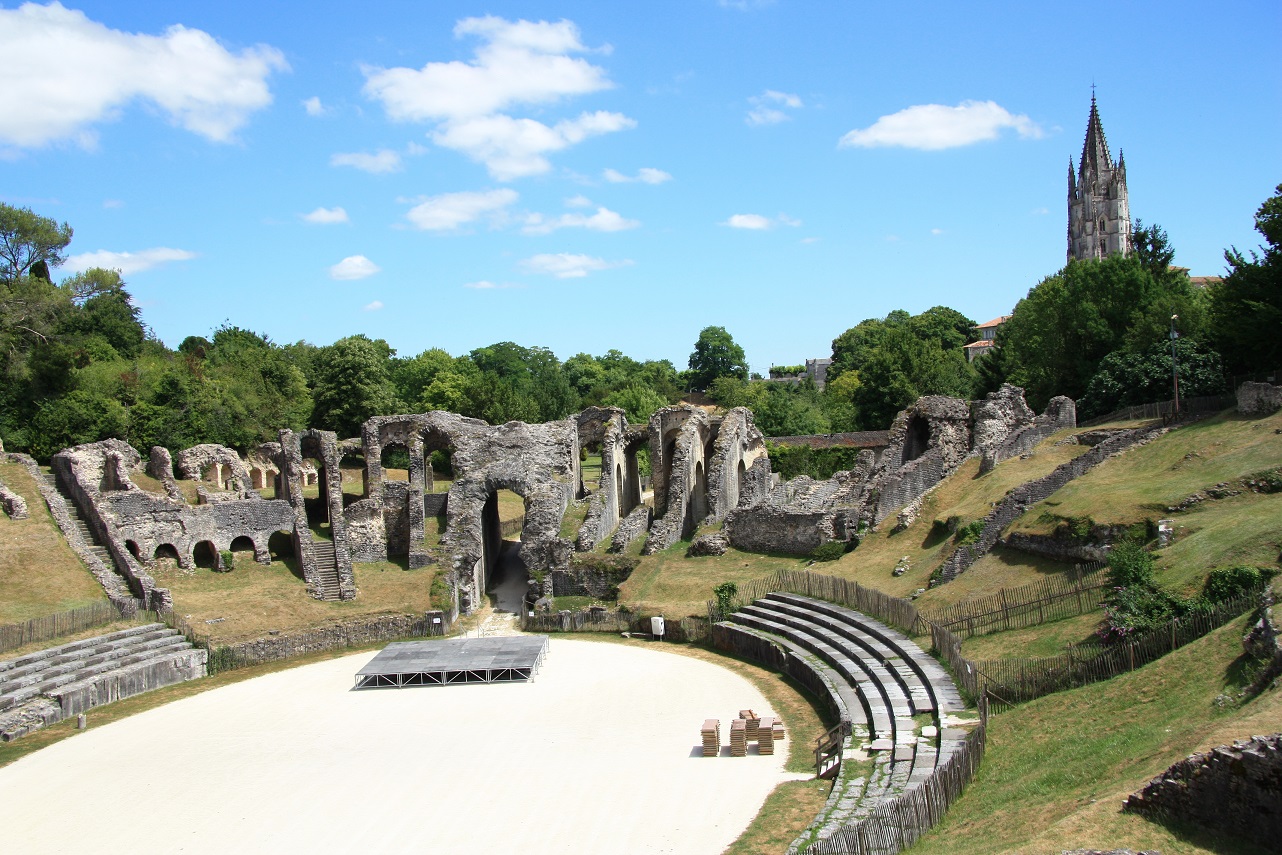
We then made our way through the town to the Roman amphitheatre, one of the oldest of the Roman world, built in the first century AD during the reign of Claudius.  The terraces, long since overgrown, accommodated up to 18,000 people.


An audioguide in English was very interesting, if a bit long!  Having purchased a “bargain” ticket for both the amphitheatre and Abbaye aux Dames we felt obliged to go there too, but it was still hot and I, for one, was flagging, so we really didn’t do it justice.


With hindsight, we should have stopped at the public gardens, from which we could hear music, or taken a boat ride on the River Charente.

The next day took us on to Cognac, which was a series of non-events!  We arrived at our chosen site to find reception didn’t open until 4 pm (it was only 12:30 pm) and finding yourself a pitch prior to registering was definitely forbidden. Instead we made our way into the town centre and found the aire (functional, not pretty) but it was somewhere to park while we visited a museum, Espace Decouverte, which would tell us all about the flat-bottomed boats called gabariers, that once carried cognac to towns in northern France.  Damnation! The museum turned out not to be open on a Monday!  This was not to be our day.

So on to Jarnac where the good weather finally deserted us, per the weather forecast.  We set up in the rain and the weather veered from hot sunny intervals to heavy rain and thunderstorms in the blink of an eye.  This rather scuppered plans, although we did manage a cycle ride on the first day along the river Charente.  The cycle “track” was just compounded earth, with potholes filled in with hardcore here and there, so it was not a comfortable ride.  The Ile of Re it was not! On the second day we sampled the restaurant adjacent to the site (L’Auberge de la Prairie) for its “menu de jour”, which turned out to be good quality and excellent value, before going on a tour of the Courvoisier Cognac distillery.


This was enlightening and made you realise what a lengthy process it is and why Cognac costs what it does.  The tasting rounded off the visit nicely and we toddled back to the ‘van.

We had stayed in Jarnac a night longer than planned; there didn’t seem to be any point in moving when the weather was the same all over France.  But tomorrow, even though the weather is forecast to be pretty much the same, we head towards the Loire …